
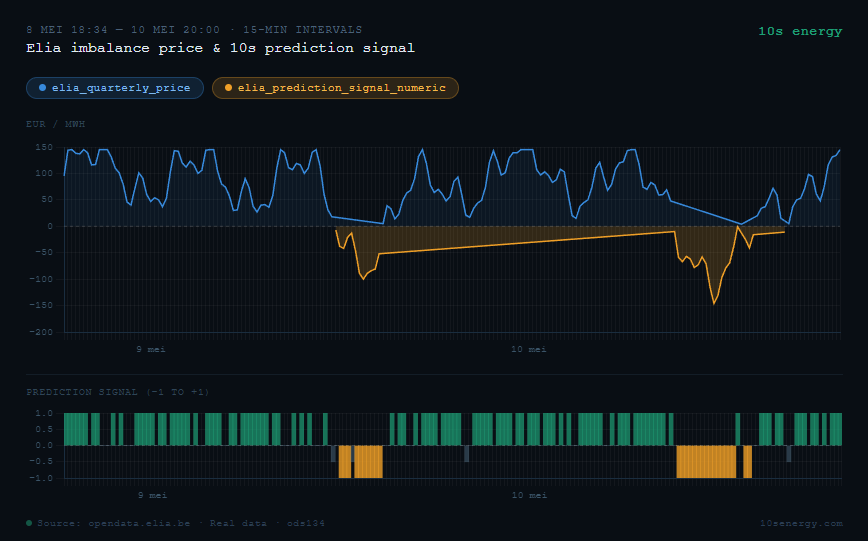
Voor Belgische bestuurders van elektrische auto’s was slim opladen vroeger een eenvoudige aangelegenheid. ’s Nachts de stekker in het stopcontact steken, de dure avondpiek vermijden, minder betalen. Toen kwam het capaciteitstarief, nam het aantal dynamische contracten toe en begonnen de realtime-balanceringsprijzen zich op een manier te gedragen die nog niemand helemaal had ingecalculeerd. Nu zijn er drie signalen die tegelijkertijd in verschillende richtingen wijzen — en de optimale oplaadstrategie hangt volledig af van naar welk signaal je luistert.
Het conflict is eenvoudig te beschrijven, maar verrassend moeilijk op te lossen. De ene tariefstructuur beloont je voor een gelijkmatig en voorspelbaar verbruik. De andere beloont je voor het concentreren van je verbruik op precies die momenten waarop het net meer elektriciteit heeft dan het aankan. Met beide kun je echt geld besparen. Onder bepaalde omstandigheden kunnen ze niet allebei tegelijkertijd de juiste keuze zijn.
Na een volledig jaar aan het opladen van elektrische auto’s volgens beide benaderingen te hebben gemodelleerd, zijn de resultaten duidelijk — en niet wat de meeste mensen verwachten.
De opzet van het probleem
Er zijn momenteel drie verschillende prijssignalen op de Belgische elektriciteitsmarkt waarop een eigenaar van een elektrische auto zijn verbruik zou kunnen afstemmen. Deze signalen werken op verschillende tijdschalen en belonen fundamenteel verschillend gedrag.
| SIGNAL 01 Capaciteitstarief. Wordt berekend op basis van het gemiddelde maandelijkse piekvermogen in kW. Tarief: € 52,95/kW/jaar excl. btw. Elke kW piekvermogen kost € 64/jaar incl. btw. | SIGNAL 02: De EPEX-spotprijzen voor de volgende dag, per kwartier, worden de dag ervoor gepubliceerd. Gemiddelde voor 2024: ~€65/MWh. Af en toe negatief, bescheiden spread. | SIGNAL 03 Onbalansprijzen: de realtime balanceringsprijs van Elia, afgerekend per 15 minuten. Kan bij een overaanbod aan hernieuwbare energie oplopen tot −€300 tot −€500/MWh. |
Tot nu toe draaide het debat vooral om de spanning tussen de eerste twee: levert zorgvuldig piekbeheer of prijsoptimalisatie voor de volgende dag het beste resultaat op? Het derde signaal — de prijs voor onbalans — is grotendeels buiten de publieke discussie gebleven. Die afwezigheid dreigt een probleem te worden, want onbalans is waar de echte cijfers te vinden zijn.
Waarom piekminimalisatie de overhand heeft op day-ahead-prijsvorming
Bij een standaard dynamisch contract dat is gekoppeld aan de spotprijzen voor de volgende dag, is het model eenduidig: het minimaliseren van je maandelijkse piekverbruik leidt tot lagere jaarlijkse kosten dan het najagen van goedkope uren.
De berekening is onaangenaam, maar onontkoombaar. Een stijging van 1 kW in je gemiddelde maandelijkse piekverbruik kost € 64 per jaar aan capaciteitstarief. Om het creëren van die hogere piek door middel van goedkope elektriciteit te rechtvaardigen, moet je € 64 aan energiebesparingen realiseren op die extra kilowatt. Gezien het gebruikelijke verschil tussen goedkope en gemiddelde day-ahead-uren vereist dat een enorme verschuiving in het verbruik.
| // Day-ahead: can aggressive charging justify a 1 kW peak increase? capacity cost of +1 kW peak: €64.07/yr // Day-ahead spread: cheap hour ~€20/MWh vs avg €65/MWh saving per kWh shifted: €0.045/kWh // Break-even: how many kWh must be shifted at cheap price to recover €64? break-even kWh: €64.07 ÷ €0.045 = 1,424 kWh // At 7.4 kW charging rate, that is 192 hours of cheap-window charging. // Most households do not come close. Peak management wins. |
De conclusie is contra-intuïtief maar robuust: bij day-ahead-prijszetting is de goedkoopste elektriciteit niet altijd de goedkoopste laadstrategie. De netwerkcomponent speelt de doorslaggevende rol. Een huishouden dat ’s nachts langzaam laadt tegen een bescheiden tarief — waardoor het verbruik wordt afgevlakt en pieken worden vermeden — presteert doorgaans beter dan een huishouden dat agressief laadt tijdens de goedkoopste uren, zelfs voordat de capaciteitsboete volledig is opgevangen.
| De praktische consequentie: bij een standaard dynamisch day-ahead-contract moet je het opladen spreiden, het gelijktijdige verbruik van apparaten beperken en denken als een netplanner in plaats van als een prijshandelaar. Het capaciteitstarief heeft het optimale consumentengedrag fundamenteel veranderd. |
Prijzen op de balanceringsmarkt: een heel ander verhaal
Alles verandert wanneer je overschakelt van dag-vooruitprijzen naar realtime onbalansprijzen.
Onbalansprijzen zijn het mechanisme dat Elia gebruikt om vraag en aanbod in realtime in evenwicht te brengen — deze worden per kwartier afgerekend wanneer de werkelijke opwekking en het werkelijke verbruik afwijken van het day-ahead-schema. Tijdens een winderige nacht of een zonnige lentemiddag, wanneer de opwekking uit zonne-energie de prognose aanzienlijk overschrijdt, kunnen de onbalansprijzen dalen tot niveaus waarbij de negatieve day-ahead-prijzen in het niet vallen.
Terwijl een goedkoop uur in de day-ahead-markt een besparing van € 0,04–0,05/kWh ten opzichte van het gemiddelde kan opleveren, kan een venster met een sterk negatieve onbalans een besparing van € 0,35–0,55/kWh opleveren. Een driefasige lader van 11 kW die 30 minuten draait tijdens een onbalansgebeurtenis van −€400/MWh levert in dat ene venster ongeveer €2,40 op. Aangezien er jaarlijks 150–200 van dergelijke gebeurtenissen plaatsvinden — een aantal dat toeneemt naarmate de capaciteit van hernieuwbare energiebronnen groeit — is het jaarlijkse winstpotentieel aanzienlijk.
| // Imbalance prices: the break-even calculation flips capacity cost of +1 kW peak: €64.07/yr // Imbalance event: −€300/MWh vs avg €65/MWh saving per kWh shifted: €0.365/kWh // Break-even: kWh needed to recover €64 capacity cost break-even kWh: €64.07 ÷ €0.365 = 175 kWh // At 7.4 kW: 23.7 hours of balancing-price charging. // With 200 events × 30 min each = 100 hrs available: math works. |
Wat nog belangrijker is: de capaciteitstariefboete geldt alleen als de intensieve laadsessie een nieuwe maandelijkse piek veroorzaakt. Als je slechtste 15 minuten van de maand al achter de rug zijn – je piek staat dan al vast op 7,4 kW – kost het verbruiken van 5 kWh extra tijdens een balanceringsgebeurtenis niets in termen van capaciteit. De volledige besparing op de onbalansprijs komt ten goede. De optimale strategie begint minder op een afweging te lijken en meer op een tweefasig probleem: stel eerst je piek zo laag mogelijk in, en verbruik vervolgens vrijuit wanneer de onbalansprijzen sterk negatief worden.
Het capaciteitstarief legt een boete op voor pieken. Op de onbalansmarkten wordt het energieverbruik op bepaalde momenten beloond. Bij voldoende verbruiksniveaus overstijgt de waarde van die marktkansen de boete van het net — en het verschil wordt elk jaar groter.
Het break-evenpunt: het punt waarop de strategie omslaat
De modellering levert een opmerkelijk heldere break-even-analyse op, gebaseerd op de maandelijkse rijafstand. In de vergelijking worden twee benaderingen rechtstreeks tegen elkaar afgezet: langzaam opladen met aandacht voor piekuren, geoptimaliseerd op basis van day-ahead-prijzen, versus snel opladen afgestemd op onbalansgebeurtenissen.
| Maandelijks aantal kilometers | Resultaat | Oordeel |
| ~500 km/maand | Strategie met langzame piek presteert beter | Langzaam maar zeker |
| ~750 km/maand | Strategieën brengen de stand in evenwicht — binnen €10 per jaar | Break-even |
| ~1.000 km/maand | De strategie van onevenwicht neemt duidelijk de leiding | Snelle overwinningen |
| >1.500 km/maand | Aanzienlijke jaarlijkse kloof in het voordeel van ‘snel’ | Snelle overwinningen, dat is duidelijk |
Bij een verbruik van ongeveer 500 km per maand — zo’n 6.000 km per jaar, wat onder het Belgische gemiddelde ligt — levert zorgvuldig piekbeheer op basis van een day-ahead-contract nog steeds een iets beter resultaat op dan agressieve heffingen op onbalans. De energievolumes zijn niet groot genoeg om ervoor te zorgen dat de voordelen van onbalans opwegen tegen de capaciteitsboete.
Bij ongeveer 750 km per maand zijn de twee strategieën even duur. De totale jaarlijkse kosten liggen slechts enkele euro’s uit elkaar.
Vanaf dat punt begint de onbalansstrategie een voorsprong op te bouwen — en de kloof wordt snel groter. De reden hiervoor is asymmetrie. Het capaciteitstarief legt op elke extra kilowatt piekverbruik een vaste jaarlijkse boete op. Maar de besparingen op onbalans nemen toe naarmate er meer energie wordt verbruikt tijdens periodes met lage tarieven. Een hoger verbruik betekent een grotere blootstelling aan die periodes. Bij 1.000 km per maand levert de onbalansstrategie een aanzienlijk jaarlijks voordeel op. Bij hogere kilometrages wordt het verschil enorm.
| GEMIDDELDE RIJAFSTAND IN BELGIË ~1.250 km/maand Febiac 2024 — de meeste regelmatige bestuurders van elektrische auto’s zitten al boven het break-evenpunt van de strategie. | BREAK-EVEN-PUNT ~750 km/maand. Boven dit punt levert snel opladen met onbalans gemiddeld genomen lagere jaarlijkse kosten op dan zorgvuldig piekbeheer. |
Het verhaal is niet eenduidig: seizoensinvloeden spelen een rol
De ‘imbalance’-strategie presteert niet elke maand beter dan de markt. Dat is een van de belangrijkste nuances in de analyse, en een van de nuances die het vaakst over het hoofd worden gezien.
De markten voor onbalans zijn sterk seizoensgebonden. In het voor- en najaar doen zich de meest frequente en grootste negatieve prijsgebeurtenissen voor — een hoge opbrengst aan zonne-energie, een gematigde vraag, een sterke offshore-wind en een beperkte opslagcapaciteit zorgen voor omstandigheden waarin het net regelmatig meer elektriciteit heeft dan het kan opnemen. In die maanden is agressief opladen uiterst aantrekkelijk en zijn de argumenten voor het optimaliseren van onbalans zeer overtuigend.
De winter is anders. De prijsschommelingen nemen af. Situaties waarin er een overaanbod aan hernieuwbare energie is, komen minder vaak voor. Pieken in de vraag naar verwarming staan hoog op de agenda van het elektriciteitsnet. In die maanden blijken conservatief opladen en zorgvuldig piekbeheer opnieuw de financieel verstandige standaardkeuze te zijn.
| WINTER (NOV–FEB) Het beheer van piekverbruik staat centraal; onbalanssituaties komen zelden voor. Het capaciteitstarief is de belangrijkste kostenvariabele. Langzaam en gelijkmatig opladen gedurende de nacht levert het beste resultaat op. Houd het weer in de gaten, niet de prijsfeed. | De strategie voor onevenwicht in de lente en de herfst speelt in op dagelijkse negatieve prijsontwikkelingen tijdens een overaanbod aan zonne-energie. Door tijdens deze periodes snel op te laden, wordt daadwerkelijke waarde gerealiseerd. Bij voldoende volumes is het de moeite waard om de capaciteitstoeslag voor rekening te nemen. |
Dit zorgt voor een dynamiek die geen enkele vaste strategie volledig kan benutten. Een EV-eigenaar die zich permanent aan een van beide benaderingen houdt, laat in ten minste enkele maanden geld liggen. Het werkelijk optimale laadprofiel is adaptief: conservatief en rekening houdend met pieken in de winter, opportunistisch en snel tijdens seizoensgebonden pieken in de opwekking van hernieuwbare energie.
Waarvoor het capaciteitstarief nooit bedoeld was
Deze analyse bevat een structurele ironie die de regelgevende instanties langzamerhand beginnen op te merken.
Het capaciteitstarief is ingevoerd om gelijktijdige verbruikspieken te ontmoedigen — de combinatie van een EV-lader, warmtepomp en oven in de avonduren, die het laagspanningsdistributienet zwaar belast. Die redenering klopt. Maar het mechanisme maakt geen onderscheid tussen een laadsessie van 7,4 kW tijdens een koude piekavond in januari en een laadsessie van 7,4 kW tijdens een zonnige namiddag in april, wanneer elk zonnepaneel in Vlaanderen overtollige energie terugvoert naar een net dat wanhopig op zoek is naar iemand om die energie op te nemen.
In het eerste geval is de piek daadwerkelijk schadelijk — hij belast een netwerk dat toch al onder druk staat. In het tweede geval is hij juist gunstig — hij helpt het overschot aan hernieuwbare energie op te vangen dat anders tot problemen bij het netbeheer zou leiden. Het capaciteitstarief bestraft beide situaties in gelijke mate. Dat is niet alleen een gemiste kans; het is een prijssignaal dat de verkeerde kant op wijst op een moment dat steeds vaker voorkomt en steeds belangrijker wordt in de werking van het net.
Deze tegenstrijdigheid is een van de belangrijkste redenen waarom het huidige tariefkader voor capaciteit, dat tot eind 2028 van kracht is, waarschijnlijk niet ongewijzigd zal blijven bestaan. Een naar tijdstip gedifferentieerd capaciteitstarief — nul tijdens periodes met veel zonne-energie en een lage vraag — of een overstap naar een kWh-structuur op basis van verbruikstijdstip naar Waals model zou dit conflict oplossen.
Wat deze cijfers vandaag de dag betekenen voor eigenaren van elektrische auto’s
De praktische conclusie van deze analyse is niet eenvoudig, maar wel concreet.
Als je een standaard dynamisch ‘day-ahead’-contract hebt en je maandelijks minder dan 750 km rijdt, blijft zorgvuldig piekbeheer je beste hulpmiddel. Verdeel het opladen over de nacht, vermijd het gelijktijdig gebruik van apparaten met een hoog stroomverbruik en de oplader, en laat de gegevens van Mijn Fluvius je laten zien waar je grootste pieken zich voordoen.
Als je maandelijks meer dan 750 km rijdt, en vooral als je toegang hebt tot realtime onbalansprijzen of een systeem dat daarop kan reageren, zou je volgens de analyse je aanpak moeten herzien. Snel opladen tijdens situaties met een grote negatieve onbalans kan op jaargemiddelde basis beter presteren dan conservatief piekbeheer — en het voordeel neemt toe naarmate het verbruik hoger is. Bij 1.250 km per maand — ruwweg het Belgische gemiddelde — bevindt u zich al in een gebied waar de onbalansstrategie in de meeste jaren een voordeel oplevert.
| Het tweefasige optimum: verlaag uw maandelijkse piekverbruik zo ver als uw levensstijl en apparatuur toelaten, om zo de vermijdbare capaciteitskosten weg te nemen. Verbruik vervolgens zo veel mogelijk tijdens onbalanssituaties, binnen de resterende piekruimte. Deze twee doelstellingen zijn niet met elkaar in strijd als ze achtereenvolgens worden uitgevoerd. Het probleem ontstaat pas wanneer u probeert om door middel van agressief opladen – wat pieken veroorzaakt – bescheiden day-ahead-spreads te benutten. |
De grotere overgang
Wat deze analyse zo belangrijk maakt, afgezien van de berekening van de besparingen per huishouden, is wat ze zegt over de richting waarin het elektriciteitssysteem als geheel zich ontwikkelt.
Decennialang waren consumenten passief. Prijzen stonden vast, tarieven waren onveranderlijk en het elektriciteitsnet kon elk gedrag van huishoudens aan. Die opzet is achterhaald. Het moderne elektriciteitsnet is in toenemende mate afhankelijk van flexibel verbruik — van consumenten die dynamisch kunnen reageren op momenten van overvloed of schaarste aan hernieuwbare energie. De huishoudens en bedrijven die daartoe in staat zijn, worden economisch gezien echt waardevol, op manieren die vaste tariefstructuren niet kunnen benutten of belonen.
Het capaciteitstarief was een vroege en belangrijke stap in de goede richting: het verlegde de toewijzing van netkosten van het verbruiksvolume naar het verbruikspatroon. Maar het was bedoeld voor een specifiek probleem — ongecontroleerde vraagpieken als gevolg van elektrificatie — en er is een vervaldatum in het ontwerp ingebouwd. De volgende versie zal een moeilijker probleem moeten oplossen: consumenten belonen voor het opvangen van overschotten aan hernieuwbare energie en hen tegelijkertijd bestraffen voor het veroorzaken van vraagpieken.
Wanneer die tariefstructuur wordt ingevoerd — en de regelgevingskalender wijst erop dat dit ergens rond 2029 zal gebeuren — zal het conflict tussen goedkope elektriciteit en netvriendelijk laadgedrag grotendeels vanzelf oplossen. De eigenaar van een elektrische auto die intensief oplaadt tijdens een periode van overaanbod aan zonne-energie, doet daarmee tegelijkertijd het juiste voor zowel zijn energierekening als het elektriciteitsnet. Het laadsysteem dat deze momenten betrouwbaar kan herkennen en erop kan reageren, zonder dat de consument daar dagelijks aandacht aan hoeft te besteden, wordt de infrastructuur die die toekomst werkelijkheid maakt.
Dat systeem bestaat op consumentenniveau nog niet volledig. Maar de cijfers die de aanleg ervan nu rechtvaardigen, zijn er wel.
Analyse op basis van een model voor het opladen van elektrische voertuigen gedurende het hele jaar. Aannames: accu van 60 kWh, verbruik van 20 kWh/100 km, oplaadrendement van 90%. Capaciteitstarief: € 52,95/kW/jaar excl. btw (Fluvius-standaard 2024–2025), factureringsdrempel van 2,5 kW, voortschrijdend gemiddelde over 12 maanden. Day-ahead-referentie: EPEX-spot, jaargemiddelde 2024 ~€ 65/MWh. Imbalansprijsgebeurtenissen: Elia ods134-dataset, ca. 180–220 gebeurtenissen/jaar onder −€ 100/MWh in 2024, gemiddelde diepte van de gebeurtenis −€ 240/MWh. De cijfers voor het break-even-rijbereik zijn indicatief en afhankelijk van aannames over de frequentie en omvang van de gebeurtenissen. Belgisch gemiddeld jaarlijks rijbereik: Febiac 2024.