
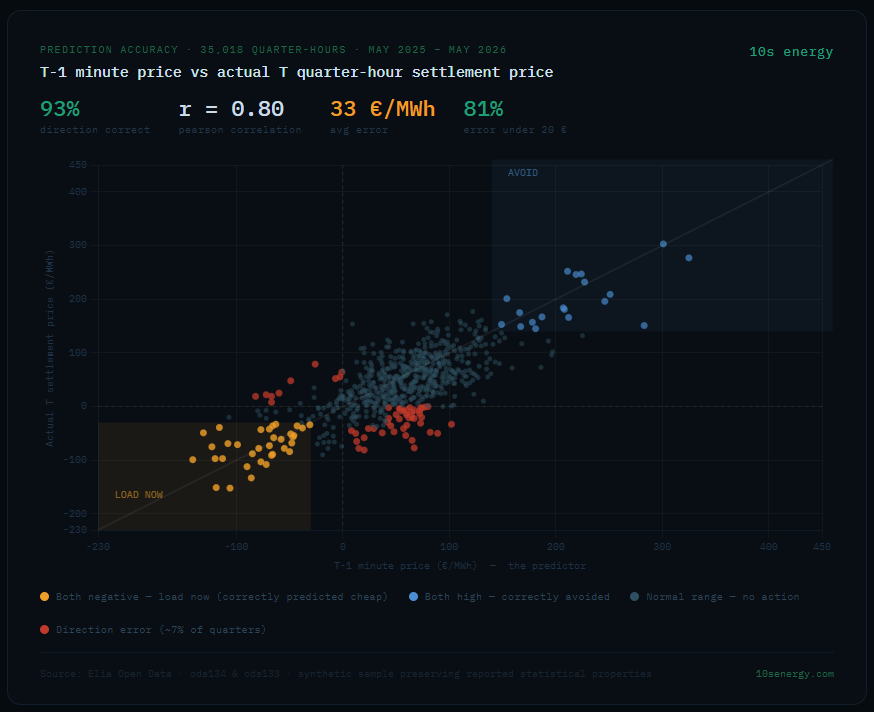
Elia stelt elke 15 minuten een prijs vast die bepaalt of het op dat moment goedkoop of duur is om elektriciteit te verbruiken. We hebben de gegevens van een heel jaar geanalyseerd om te achterhalen hoe goed je die prijs kunt voorspellen — voordat hij wordt vastgesteld.
Ten eerste: wat is een onevenwichtige prijs?
Het elektriciteitsnet moet op elk moment perfect in evenwicht zijn: er moet evenveel stroom binnenkomen als eruit gaat. Wanneer dat evenwicht verstoord raakt, grijpt Elia (de Belgische netbeheerder) in om dit te corrigeren, door elektriciteitscentrales te vragen hun productie op te voeren of consumenten te vragen hun verbruik te verminderen. De onbalansprijs is de kostprijs van die correctie, die om de 15 minuten wordt verrekend.
Wanneer er een tekort is op het net — meer verbruik dan productie — stijgt de prijs, soms zelfs sterk. Wanneer er een overschot is op het net — meer productie dan verbruik, vaak op zonnige of winderige dagen — daalt de prijs en kan deze zelfs negatief worden. Dat betekent dat Elia je in feite betaalt om elektriciteit te verbruiken.
| WAAROM IS DIT BELANGRIJK VOOR U? Als u een flexibele verbruiker hebt — een EV-lader, een thuisaccu, een warmtepomp — en u bent aangesloten bij een leverancier die de onbalansprijs doorberekent, dan kunt u geld besparen door op te laden wanneer de prijs laag is en het opladen te onderbreken wanneer de prijs hoog is. De vraag is: kunt u dat van tevoren weten? |
Het probleem: de prijs wordt pas achteraf bekendgemaakt
Elia maakt de officiële 15-minutenprijs pas bekend nadat het kwartier is afgelopen. Tegen die tijd is het te laat om nog actie te ondernemen. De echte vraag is dus: kun je aan het begin van een kwartier een voldoende goede inschatting maken om te beslissen of je wel of niet moet laden?
Gelukkig publiceert Elia ook een stroom van realtimegegevens die elke minuut wordt bijgewerkt: de actuele prijsraming per minuut, de systeemonbalans in megawatt en de activeringsprijzen van de balanceringsbiedingen. Deze gegevens zijn gratis en openbaar beschikbaar. We hebben ze gebruikt om een voorspellingsmodel te ontwikkelen en hebben dit getest aan de hand van een volledig jaar aan werkelijke resultaten.
Het korte antwoord: ja — meestal
Het allerbelangrijkste signaal is de laatst gepubliceerde minuutkoers van het voorgaande kwartier. Je beschikt al over dat cijfer nog voordat het nieuwe kwartier begint. Dit is wat het je vertelt:
| RICHTING CORRECT 93% positief of negatief, correct voorspeld | GEMIDDELDE FOUT 33 €/MWh: gemiddelde absolute fout in het prijsniveau | FOUT ONDER 20 € 81% van alle kwarturen | PRIJSCORRELATIE 0,80 T-1 tot T, Pearson r |
Simpel gezegd: als de koers in het afgelopen kwartier erg laag of negatief was, is de kans 93% dat dit ook voor het volgende kwartier geldt. Als de koers hoog was, zal deze vrijwel zeker hoog blijven. Het exacte percentage is moeilijker vast te stellen, maar de richting — moet ik nu instappen of niet? — is betrouwbaar genoeg om ernaar te handelen.
| HET BELANGRIJKSTE INZICHT Bij domotica hoef je niet precies te weten of de prijs precies -47 €/MWh zal bedragen. Je hoeft alleen maar te weten dat deze erg laag zal zijn. Alleen al de richtingaanwijzing is voldoende om goede beslissingen te nemen. |
Het wordt beter als je 5 minuten wacht
Je hoeft niet meteen aan het begin van een kwartier een beslissing te nemen. De meeste flexibele verbruikers — EV-laders, accu’s, warmtepompen — kunnen een vertraging van enkele minuten wel aan. Als je slechts 5 minuten wacht en de eerste paar realtime minuutprijzen van het nieuwe kwartier bekijkt, wordt de voorspelling merkbaar nauwkeuriger.
| :00 | Kwartieraanvangstijden — nu beslissen? Gebruik de last-minuteprijs van het vorige kwartaal. Gemiddelde fout: 33 €/MWh. Richting: 93% correct. |
| :03 | Wacht 3 minuten. Gemiddelde van 3 realtime minuutprijzen. De fout daalt tot 26 €/MWh. Richting: 94% correct. |
| :05 | Wacht 5 minuten — aanbevolen Fout: 23 €/MWh. Richting: 94% correct. Goede balans tussen snelheid en nauwkeurigheid. |
| :10 | Wacht 10 minuten — de foutmarge daalt tot 18 €/MWh, de richting is voor 95% correct. Maar je hebt nog maar 5 minuten om hiervan te profiteren. |
| :15 | Het kwartier is afgelopen — de prijs is bekendgemaakt. Te laat om nog iets te doen. Elia bevestigt de officiële afrekenprijs. |
Hoe nauwkeurig is ‘nauwkeurig genoeg’?
Wat als een goede voorspelling geldt, hangt af van wat je ermee wilt doen. De drie onderstaande scenario’s dekken de meeste toepassingen op het gebied van domotica.
| ▼ Zeer goedkoop — nu laden. Prijs onder −50 €/MWh. Deze momenten zijn zeldzaam (3,7% van het jaar), maar zeer waardevol. Het voorspellingsmodel signaleert 71% ervan van tevoren. Wanneer het model een signaal geeft, bedraagt de gemiddelde werkelijke prijs −153 €/MWh — sterk negatief. | — Normaal — niets doen. Prijs tussen 0 en 100 €/MWh. Dit geldt voor 70% van alle kwarturen. Er zijn geen specifieke maatregelen nodig. Het voorspellingsmodel identificeert deze zone 9 van de 10 keer correct. | ▲ Zeer duur — laden onderbreken. Prijs boven 150 €/MWh. Zodra een fase met hoge prijzen begint, houdt deze aan: er is 96% kans dat deze het volgende kwartaal voortduurt. De voorspeller detecteert deze situaties betrouwbaar en activeert een onderbreking. |
De prijzen blijven meestal op hetzelfde niveau
Een van de meest bruikbare eigenschappen van de Belgische onbalansprijs is de neiging om aan te houden. Zodra de prijs zich in een bepaald regime bevindt, blijft hij daar doorgaans ook. Dit maakt het voorgaande kwartier tot zo’n sterke voorspeller.
Hoge prijs blijft hoog 96%
De lage prijs blijft laag 71%
Over het algemeen juiste richting 93%
Fout onder 20 €/MWh 81%
Regimes met hoge prijzen zijn hardnekkiger dan die met lage prijzen. Een negatieve prijs kan binnen een kwartier weer omslaan naar positief — het is een kortstondige kans. Een periode met hoge prijzen duurt doorgaans langer en is gemakkelijker te vermijden.
Dat hangt af van het tijdstip van de dag
Niet alle uren zijn even voorspelbaar. ’s Nachts en vroeg in de ochtend (van middernacht tot 06.00 uur) zijn de prijzen stabiel en presteert het voorspellingsmodel goed. De lastigste tijdstippen zijn de ochtendspits (07.00–09.00 uur) en de avondspits (17.00–20.00 uur), wanneer de vraag snel verandert en het net tussen verschillende toestanden schakelt.
| VUISTREGEL Vertrouw het meest op de voorspeller tijdens stabiele periodes: ’s nachts, in het weekend en rond het middaguur op zonnige dagen (wanneer de zonne-energie voorspelbaar hoog is). Wees voorzichtiger tijdens de ochtend- en avondspits op weekdagen — dan is de kans het grootst dat de markt je verrast. |
Dat verschilt per seizoen
| Zomer (jun–aug): 15% negatieve kwarturen. De zonne-energieproductie zorgt voor regelmatige periodes met lage prijzen, vooral rond het middaguur. Geschikt voor opportunistisch verbruik. De gemiddelde prijs bedroeg 69 €/MWh. | Lente (maart–mei): 13% negatieve kwarturen. Variabel — de mix van wind- en zonne-energie zorgt zowel voor dalingen als pieken. In de week van 6 april 2026 waren er extreme prijzen in beide richtingen. Gemiddelde: 68 €/MWh. |
| Herfst (sep.–nov.) 11% negatieve kwarturen. De prijzen beginnen te stijgen naarmate de vraag naar verwarming toeneemt. Oktober en november markeren het begin van het hoogseizoen. Gemiddelde: 76 €/MWh. | Winter (dec.–feb.) Slechts 4% negatieve kwarturen. Door de hoge vraag naar verwarming blijven de prijzen hoog. In januari 2026 bedroeg het gemiddelde 116 €/MWh. Er zijn minder mogelijkheden om goedkoop stroom af te nemen, maar het vermijden van hoge prijzen is belangrijker. |
Wat de voorspeller niet kan
Er zijn situaties waarin zelfs het beste realtime-signaal je geen waarschuwing geeft. De meest voorkomende situatie is een MARI-activering aan het einde van een kwartier — wanneer Elia in de laatste minuten van een kwartier een beroep doet op grote balanceringsbiedingen, kan de prijs van 80 naar 300 €/MWh springen zonder dat dit vooraf in de minuutgegevens te zien is.
| BEKENDE STORINGSMODUS Op 6 april 2026 kwam de prijs gedurende vijf opeenvolgende kwarturen uit op −15.000 €/MWh — een extreme gebeurtenis die het jaar daarvoor nog niet was voorgekomen. De gegevens per minuut lieten niets ongewoons zien. Een automatiseringssysteem dat hierop had gereageerd, zou puur geluk hebben gehad, en niet slim zijn geweest. Om deze reden bevat het systeem een filter dat elke prijs buiten het bereik van ±500 €/MWh negeert als waarschijnlijke ruis. |
De totale foutverdeling laat het volgende zien: 64% van de kwarturen heeft een voorspellingsfout van minder dan 10 €/MWh, en 81% ligt onder de 20 €/MWh. Maar de resterende 19% omvat een lange staart van grote fouten — voornamelijk veroorzaakt door deze activeringsgebeurtenissen aan het einde van het kwartaal. Voor een thuisaccu kun je je af en toe een gemiste piek veroorloven. Voor een commerciële BRP met strikte afrekeningsverplichtingen heb je een geavanceerder model nodig.
Waar het bij domotica uiteindelijk om draait
Dit is wat je volgens de gegevens redelijkerwijs kunt doen:
| WAT WERKT : Schakel in wanneer de prijs van het voorgaande kwartier onder −50 €/MWh lag. Dit gebeurt ongeveer 1.300 keer per jaar (3,6% van de kwartieren), vooral in de zomer en de lente. Wanneer dit gebeurt, bedraagt de gemiddelde prijs die je daadwerkelijk betaalt −153 €/MWh — het net heeft een aanzienlijk overschot en Elia is blij dat je verbruikt. Wacht 5 minuten na het begin van het kwartier om het signaal te bevestigen voordat je de strategie activeert. Pauzeer wanneer de prijs boven 150 €/MWh ligt. Zodra je in een fase met hoge prijzen zit, is de kans 96% dat het volgende kwartier ook hoog is. Je hoeft je niet te haasten om terug te keren — wacht op een duidelijke daling tot onder 50 €/MWh voordat je weer verdergaat. |
| WAT NIET WERKT: Proberen te handelen op basis van het exacte prijsniveau. De gemiddelde afwijking van 33 €/MWh betekent dat je geen betrouwbaar onderscheid kunt maken tussen bijvoorbeeld 60 en 90 €/MWh. Het signaal is nuttig voor extreme beslissingen — duidelijk goedkoop of duidelijk duur — maar niet voor gedetailleerde optimalisatie. |
Deze toelichting is gebaseerd op een analyse van de open data van Elia over een volledig jaar (datasets ods134 en ods133, mei 2025–mei 2026, 35.018 kwartieruren). De onderliggende gegevens en het Python-analysescript zijn beschikbaar om de analyse te herhalen. Alle gegevens over onbalansprijzen worden door Elia gepubliceerd onder een open-data-licentie.