
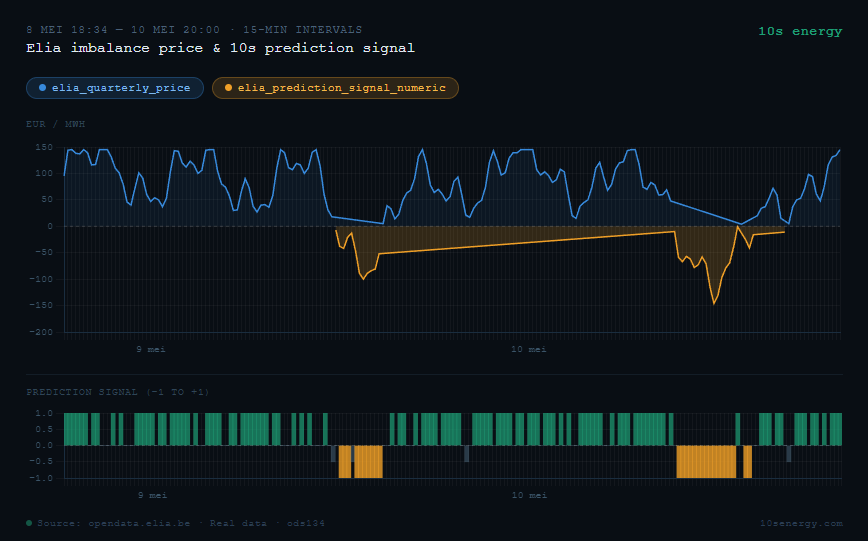
Pour les conducteurs belges de véhicules électriques, la recharge intelligente était autrefois une affaire simple : brancher son véhicule la nuit, éviter les tarifs élevés des heures de pointe du soir, payer moins cher. Puis le tarif de capacité a fait son apparition, les contrats dynamiques se sont multipliés et les prix d'équilibrage en temps réel ont commencé à évoluer d'une manière que personne n'avait encore tout à fait anticipée. Aujourd'hui, trois signaux s'opposent simultanément — et la stratégie de recharge optimale dépend entièrement de celui auquel on prête attention.
Ce dilemme est simple à décrire, mais étonnamment difficile à résoudre. Une structure tarifaire vous récompense si vous répartissez votre consommation de manière régulière et prévisible. Une autre vous récompense si vous concentrez votre consommation précisément aux moments où le réseau dispose de plus d’électricité qu’il ne peut en absorber. Les deux peuvent vous permettre de réaliser de réelles économies. Dans certaines conditions, elles ne peuvent toutefois pas être toutes les deux valables en même temps.
Après avoir modélisé une année complète de recharge de véhicules électriques selon ces deux approches, les résultats sont sans équivoque — et ne correspondent pas à ce à quoi s'attend la plupart des gens.
La structure du problème
Il existe actuellement trois signaux de prix distincts sur le marché belge de l'électricité que le propriétaire d'un véhicule électrique pourrait exploiter à son avantage. Ceux-ci s'appliquent à des échelles de temps différentes et récompensent des comportements fondamentalement différents.
| SIGNAL 01 Tarif de puissance: facturé sur la base de la puissance de pointe mensuelle moyenne en kW. Tarif : 52,95 €/kW/an, hors TVA. Chaque kW de puissance de pointe coûte 64 €/an, TVA comprise. | SIGNAL 02 : Prix spot EPEX à un quart d'heure près pour le lendemain, publiés la veille. Moyenne 2024 : environ 65 €/MWh. Parfois négatifs, écart modeste. | SIGNAL 03 Prix de déséquilibre: prix d'équilibrage en temps réel d'Elia, calculé toutes les 15 minutes. Peut atteindre entre −300 et −500 €/MWh en cas d'excédent d'énergie renouvelable. |
Jusqu’à présent, le débat s’est principalement concentré sur la tension entre les deux premiers éléments : qu’est-ce qui donne les meilleurs résultats, une gestion rigoureuse des pics de consommation ou l’optimisation des prix à un jour ? Le troisième signal — la tarification des déséquilibres — a été largement absent du débat public. Cette absence est sur le point de devenir un problème, car c’est dans les déséquilibres que se trouvent les chiffres réels.
Pourquoi la minimisation des pics l'emporte sur la tarification journalière
Dans le cadre d'un contrat dynamique standard indexé sur les prix spot du marché du jour le lendemain, la modélisation est sans ambiguïté : minimiser sa consommation mensuelle de pointe permet de réduire les coûts annuels davantage que de rechercher les heures les moins chères.
Le calcul est peu réjouissant, mais incontournable. Une augmentation de 1 kW de votre pic mensuel moyen coûte 64 € par an en tarif de capacité. Pour justifier la création de ce pic plus élevé grâce à de l’électricité bon marché, vous devez récupérer ces 64 € sous forme d’économies d’énergie sur ce kilowatt supplémentaire. Compte tenu de l’écart habituel entre les heures les moins chères et les heures moyennes du marché journalier, cela nécessite un report considérable de la consommation.
| // Day-ahead: can aggressive charging justify a 1 kW peak increase? capacity cost of +1 kW peak: €64.07/yr // Day-ahead spread: cheap hour ~€20/MWh vs avg €65/MWh saving per kWh shifted: €0.045/kWh // Break-even: how many kWh must be shifted at cheap price to recover €64? break-even kWh: €64.07 ÷ €0.045 = 1,424 kWh // At 7.4 kW charging rate, that is 192 hours of cheap-window charging. // Most households do not come close. Peak management wins. |
La conclusion est contre-intuitive mais solide : dans le cadre d'une tarification « day-ahead », l'électricité la moins chère ne correspond pas toujours à la stratégie de recharge la plus économique. La composante « réseau » est prépondérante. Un foyer qui recharge lentement pendant la nuit à un tarif modéré — en lissant sa charge et en évitant les pics — obtient généralement de meilleurs résultats qu'un foyer qui recharge de manière intensive pendant les heures les moins chères, même avant que la pénalité de capacité ne soit entièrement absorbée.
| Conséquence pratique : dans le cadre d'un contrat standard de marché journalier dynamique, il convient d'étaler les recharges, de limiter les charges simultanées des appareils électroménagers et d'adopter une approche de planificateur de réseau plutôt que celle d'un opérateur spéculatif. Le tarif de capacité a radicalement modifié le comportement optimal des consommateurs. |
Les prix de déséquilibre : une tout autre donne
Tout change lorsque l'on passe des prix du marché journalier aux prix de déséquilibre en temps réel.
Les prix de déséquilibre constituent le mécanisme mis en place par Elia pour équilibrer l'offre et la demande en temps réel ; ils sont calculés par quart d'heure lorsque la production et la consommation réelles s'écartent du programme de la journée suivante. Lors d'une nuit venteuse ou d'un après-midi ensoleillé de printemps, lorsque la production solaire dépasse largement les prévisions, les prix de déséquilibre peuvent chuter à des niveaux qui font paraître modestes les prix négatifs du marché journalier.
Alors qu’une heure bon marché sur le marché journalier peut permettre d’économiser entre 0,04 et 0,05 €/kWh par rapport à la moyenne, une fenêtre de déséquilibre fortement négative peut permettre d’économiser entre 0,35 et 0,55 €/kWh. Un chargeur triphasé de 11 kW fonctionnant pendant 30 minutes lors d’un événement de déséquilibre à −400 €/MWh permet de récupérer environ 2,40 € au cours de cette seule fenêtre. Avec 150 à 200 événements de ce type par an — un nombre qui augmente à mesure que la capacité des énergies renouvelables se développe —, le potentiel annuel est considérable.
| // Imbalance prices: the break-even calculation flips capacity cost of +1 kW peak: €64.07/yr // Imbalance event: −€300/MWh vs avg €65/MWh saving per kWh shifted: €0.365/kWh // Break-even: kWh needed to recover €64 capacity cost break-even kWh: €64.07 ÷ €0.365 = 175 kWh // At 7.4 kW: 23.7 hours of balancing-price charging. // With 200 events × 30 min each = 100 hrs available: math works. |
Plus important encore, la pénalité tarifaire liée à la capacité ne s’applique que si la session de recharge intensive génère un nouveau pic mensuel. Si vos 15 minutes les plus gourmandes du mois ont déjà eu lieu — votre pic est déjà fixé à 7,4 kW —, alors consommer 5 kWh supplémentaires lors d’un événement de déséquilibre ne coûte rien en termes de capacité. L’intégralité des économies réalisées sur le déséquilibre est répercutée. La stratégie optimale commence à ressembler moins à un compromis qu’à un problème en deux phases : fixez d’abord votre pic au niveau le plus bas possible, puis consommez librement dès que les prix du déséquilibre deviennent fortement négatifs.
Le tarif de capacité pénalise les pics de consommation. Les marchés de l'équilibre récompensent le volume d'énergie consommé à certains moments précis. Lorsque les niveaux de consommation sont suffisamment élevés, la valeur de ces opportunités de marché dépasse la pénalité imposée par le réseau — et l'écart ne cesse de se creuser d'année en année.
Le seuil de rentabilité : le moment où la stratégie bascule
La modélisation permet d'obtenir une analyse du seuil de rentabilité remarquablement claire, basée sur le kilométrage mensuel. La comparaison oppose directement deux approches : une recharge lente, tenant compte des heures de pointe et optimisée en fonction des prix du marché journalier, et une recharge rapide programmée en fonction des événements de déséquilibre.
| Kilométrage mensuel | Résultat | Verdict |
| environ 500 km/mois | La stratégie « Slow Peak » affiche de meilleurs résultats | Les victoires à petit pas |
| environ 750 km/mois | Les stratégies s'équilibrent — dans une fourchette de 10 € par an | Seuil de rentabilité |
| environ 1 000 km/mois | La stratégie de déséquilibre prend clairement le dessus | Des victoires rapides |
| >1 500 km/mois | Écart annuel important en faveur du « fast » | Des victoires rapides, c'est évident |
À environ 500 km par mois — soit environ 6 000 km par an, un chiffre inférieur à la moyenne belge —, une gestion rigoureuse des pics dans le cadre d’un contrat « day-ahead » reste légèrement plus avantageuse qu’une facturation agressive des déséquilibres. Les volumes d’énergie ne sont pas suffisamment importants pour que les gains liés aux déséquilibres l’emportent sur la pénalité de capacité.
À partir d'environ 750 km par mois, les deux stratégies se valent. Les coûts annuels totaux ne diffèrent que de quelques euros.
Au-delà de ce seuil, la stratégie de déséquilibre commence à prendre le dessus — et l’écart se creuse rapidement. La raison en est l’asymétrie. Le tarif de capacité pénalise chaque kilowatt supplémentaire de puissance de pointe à un taux annuel fixe. En revanche, les économies réalisées sur le déséquilibre augmentent proportionnellement à l’énergie consommée pendant les périodes où les tarifs sont bas. Une consommation plus élevée implique une plus grande exposition à ces créneaux horaires. À 1 000 km par mois, la stratégie de déséquilibre génère un avantage annuel substantiel. À des kilométrages plus élevés, l’écart devient spectaculaire.
| KILOMÉTRAGE MOYEN EN BELGIQUE : environ 1 250 km/mois (Febiac 2024) — la plupart des conducteurs réguliers de véhicules électriques ont déjà dépassé le seuil de rentabilité prévu par la stratégie. | SEUIL DE RENTABILITÉ ~750 km/mo. Au-delà de ce seuil, la recharge rapide en mode « déséquilibre » s’avère plus avantageuse que la gestion prudente des pics de consommation en termes de coût annuel moyen. |
La situation n'est pas unidimensionnelle : la saisonnalité joue un rôle important
La stratégie de déséquilibre ne génère pas de surperformance tous les mois. C'est l'une des nuances les plus importantes de l'analyse, et l'une de celles qui sont le plus souvent négligées.
Les marchés des déséquilibres sont fortement soumis aux variations saisonnières. C'est au printemps et à l'automne que l'on observe les épisodes de prix négatifs les plus fréquents et les plus marqués : une production solaire élevée, une demande modérée, un vent offshore fort et une capacité de stockage limitée créent des conditions dans lesquelles le réseau dispose régulièrement de plus d'électricité qu'il ne peut en absorber. Au cours de ces mois, la recharge intensive est extrêmement intéressante et les arguments en faveur de l'optimisation des déséquilibres sont convaincants.
L'hiver est différent. La volatilité des prix s'atténue. Les situations d'offre excédentaire d'énergies renouvelables se font plus rares. Les pics de demande liés au froid occupent le devant de la scène pour le réseau. Au cours de ces mois-là, une recharge prudente et une gestion rigoureuse des pics de consommation s'imposent à nouveau comme la solution par défaut la plus judicieuse sur le plan financier.
| HIVER (NOV–FÉV) La gestion des pics de consommation est prépondérante; les événements de déséquilibre sont rares. Le tarif de capacité constitue la principale variable de coût. Une recharge lente et constante tout au long de la nuit offre les meilleurs résultats. Surveillez la météo, et non les fluctuations des prix. | STRATÉGIE DE DÉSÉQUILIBRE PRINTEMPS ET AUTOMNE : tirer parti des fluctuations quotidiennes négatives des prix en période de surproduction solaire. La recharge rapide pendant ces périodes permet de générer une réelle valeur ajoutée. La pénalité liée au tarif de capacité vaut la peine d'être assumée lorsque les volumes sont suffisants. |
Il en résulte une dynamique qu’aucune stratégie figée ne peut exploiter pleinement. Un propriétaire de véhicule électrique qui s’en tiendrait de manière permanente à l’une ou l’autre de ces approches passerait à côté d’économies, au moins certains mois. Le profil de recharge véritablement optimal est adaptatif : prudent et tenant compte des pics de consommation en hiver, opportuniste et rapide pendant les pics saisonniers d’énergie renouvelable.
Ce que le tarif de capacité n'a jamais été conçu pour prendre en charge
Cette analyse recèle une ironie structurelle que les autorités de régulation commencent à percevoir.
Le tarif de capacité a été mis en place pour décourager les charges simultanées de forte puissance — notamment la combinaison, en soirée, d’un chargeur de véhicule électrique, d’une pompe à chaleur et d’un four, qui sollicite fortement le réseau de distribution basse tension. Cette logique est tout à fait valable. Mais ce mécanisme ne fait pas la distinction entre une session de recharge de 7,4 kW pendant une soirée froide de janvier, en période de pointe, et une session de recharge de 7,4 kW lors d’un après-midi ensoleillé d’avril, alors que tous les panneaux solaires de Flandre réinjectent leur surplus d’énergie dans un réseau qui a désespérément besoin que quelqu’un l’absorbe.
Dans le premier cas, ce pic est véritablement néfaste : il alourdit la charge d’un réseau déjà sollicité. Dans le second, il est au contraire bénéfique : il contribue à absorber un excédent d’énergie renouvelable qui, sans cela, poserait des problèmes de gestion du réseau. Le tarif de capacité pénalise les deux cas de la même manière. Il ne s’agit pas seulement d’une occasion manquée ; c’est un signal de prix qui va dans la mauvaise direction, à un moment de plus en plus fréquent et crucial du fonctionnement du réseau.
Cette contradiction est l'une des principales raisons pour lesquelles le cadre tarifaire actuel en matière de capacité, en vigueur jusqu'à fin 2028, a peu de chances de perdurer tel quel. Un tarif de capacité différencié en fonction des heures — nul pendant les périodes de forte production solaire et de faible demande — ou l'adoption d'une structure tarifaire par kWh en fonction de l'heure de consommation, à l'image du modèle wallon, permettrait de résoudre ce conflit.
Ce que ces chiffres signifient pour les propriétaires de véhicules électriques aujourd'hui
La conclusion pratique de cette analyse n'est pas simple, mais elle est précise.
Si vous avez souscrit un contrat dynamique standard « day-ahead » et que votre kilométrage mensuel est inférieur à 750 km, une gestion rigoureuse des pics de consommation reste votre meilleur atout. Répartissez vos recharges sur la nuit, évitez d’utiliser des appareils à forte consommation en même temps que le chargeur, et laissez les données de Mijn Fluvius vous indiquer où se produisent vos pires pics de consommation.
Si votre kilométrage mensuel dépasse régulièrement les 750 km, et en particulier si vous avez accès à une tarification des déséquilibres en temps réel ou à un système capable d’agir en conséquence, l’analyse indique que vous devriez envisager les choses différemment. La recharge rapide lors d'événements de déséquilibre négatif important peut s'avérer plus performante qu'une gestion prudente des pics de consommation en moyenne annuelle — et cet avantage s'accentue à mesure que la consommation augmente. À 1 250 km par mois — ce qui correspond à peu près à la moyenne belge —, vous vous situez déjà dans une fourchette où la stratégie de déséquilibre présente un avantage la plupart des années.
| L'optimum en deux phases : réduire votre pic mensuel autant que votre mode de vie et votre équipement le permettent, afin d'éliminer les coûts de capacité évitables. Ensuite, consommer de manière intensive lors des événements de déséquilibre, dans la limite de la marge de pic restante. Ces deux objectifs ne sont pas contradictoires s'ils sont mis en œuvre de manière séquentielle. Le problème ne se pose que lorsque l'on tente d'utiliser une recharge intensive génératrice de pic pour tirer parti de modestes écarts de prix sur le marché du jour précédent. |
La transition la plus importante
Ce qui confère à cette analyse toute son importance, au-delà du simple calcul des économies réalisées par les ménages, c'est ce qu'elle révèle quant à l'orientation du système électrique dans son ensemble.
Pendant des décennies, les consommateurs sont restés passifs. Les prix étaient fixes, les tarifs immuables, et le réseau s'adaptait quel que soit le comportement adopté par les ménages. Cette architecture est désormais obsolète. Le réseau moderne dépend de plus en plus d'une consommation flexible, c'est-à-dire de consommateurs capables de réagir de manière dynamique aux pics d'abondance et aux périodes de pénurie d'énergies renouvelables. Les ménages et les entreprises capables d'une telle réactivité acquièrent une véritable valeur économique, que les structures à tarifs fixes ne peuvent ni prendre en compte ni récompenser.
Le tarif de capacité a constitué une première étape importante dans la bonne direction : il a permis de faire évoluer la répartition des coûts du réseau, en passant du volume de consommation aux habitudes de consommation. Mais il a été conçu pour répondre à un problème spécifique — les pics de demande incontrôlés liés à l’électrification — et sa durée de validité est intrinsèquement liée à sa conception. La prochaine version devra résoudre un problème plus complexe : récompenser les consommateurs qui absorbent les excédents d’énergie renouvelable tout en les pénalisant lorsqu’ils génèrent des pics de demande.
Lorsque cette structure tarifaire sera mise en place — et le calendrier réglementaire laisse penser que ce sera le cas vers 2029 —, le conflit entre une électricité bon marché et un comportement de recharge respectueux du réseau se résoudra en grande partie de lui-même. Le propriétaire d’un véhicule électrique qui rechargera massivement son véhicule lors d’un pic de production solaire agira ainsi dans l’intérêt à la fois de sa facture et du réseau. Le système de recharge capable d’identifier de manière fiable ces moments et d’agir en conséquence, sans nécessiter une attention quotidienne de la part du consommateur, deviendra l’infrastructure qui rendra cet avenir possible.
Ce système n'existe pas encore pleinement à l'échelle grand public. Mais les chiffres qui justifient sa mise en place dès maintenant sont bien là.
Analyse basée sur un modèle de recharge de véhicules électriques sur l'ensemble de l'année. Hypothèses : batterie de 60 kWh, consommation de 20 kWh/100 km, rendement de recharge de 90 %. Tarif de capacité : 52,95 €/kW/an hors TVA (tarif standard Fluvius 2024-2025), seuil de facturation de 2,5 kW, moyenne mobile sur 12 mois. Référence pour le marché journalier : EPEX spot, moyenne annuelle 2024 ~65 €/MWh. Événements de prix de déséquilibre : ensemble de données Elia ods134, environ 180 à 220 événements/an inférieurs à −100 €/MWh en 2024, amplitude moyenne des événements de −240 €/MWh. Les chiffres relatifs au kilométrage d'équilibre sont indicatifs et dépendent des hypothèses concernant la fréquence et l'ampleur des événements. Kilométrage annuel moyen en Belgique : Febiac 2024.