
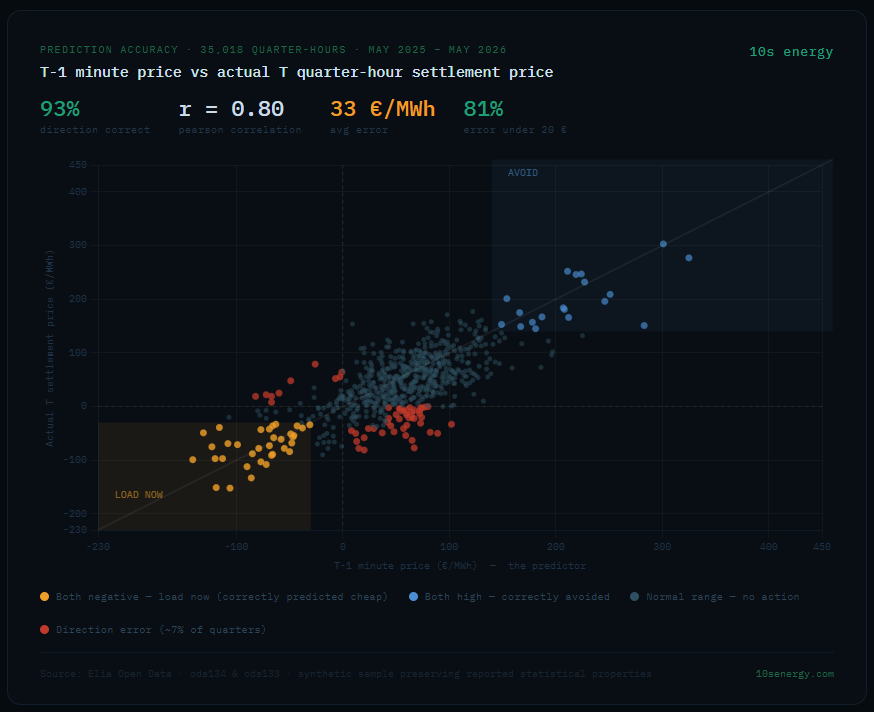
Toutes les 15 minutes, Elia fixe un prix qui détermine s'il est avantageux ou coûteux de consommer de l'électricité à ce moment-là. Nous avons analysé les données d'une année entière afin de déterminer dans quelle mesure vous êtes capable de deviner ce prix — avant qu'il ne soit fixé.
Tout d'abord, qu'est-ce qu'un prix de déséquilibre ?
Le réseau électrique doit être en parfait équilibre à tout moment : la quantité d'électricité qui y entre doit être égale à celle qui en sort. Lorsque cet équilibre est rompu, Elia (le gestionnaire du réseau belge) intervient pour le rétablir, en demandant aux centrales électriques d'augmenter leur production ou aux consommateurs de réduire leur consommation. Le prix du déséquilibre correspond au coût de cette correction, calculé toutes les 15 minutes.
Lorsque le réseau est en déficit — c'est-à-dire que la consommation est supérieure à la production —, le prix augmente, parfois de manière significative. Lorsque le réseau est en excédent — c'est-à-dire que la production est supérieure à la consommation, souvent lors des journées ensoleillées ou venteuses —, le prix baisse et peut même devenir négatif. Cela signifie qu'Elia vous paie en fait pour consommer de l'électricité.
| EN QUOI CELA VOUS CONCERNE-T-IL ? Si vous disposez d'une charge flexible (un chargeur de véhicule électrique, une batterie domestique, une pompe à chaleur) et que vous êtes abonné chez un fournisseur qui répercute le prix de déséquilibre, vous pouvez réaliser des économies en rechargeant lorsque le prix est bas et en interrompant la recharge lorsqu'il est élevé. La question est la suivante : pouvez-vous le savoir à l'avance ? |
Le problème : le prix est publié a posteriori
Elia ne publie le prix officiel du quart d'heure qu'une fois celui-ci écoulé. À ce moment-là, il est trop tard pour agir. La véritable question est donc la suivante : est-il possible, dès le début d'un quart d'heure, de faire une estimation suffisamment précise pour décider s'il faut injecter de l'électricité ou non ?
Heureusement, Elia publie également un flux de données en temps réel mis à jour toutes les minutes : l'estimation du prix minute par minute, le déséquilibre du réseau en mégawatts et les prix de déclenchement des offres d'équilibrage. Ces données sont gratuites et accessibles au public. Nous les avons utilisées pour élaborer un modèle prédictif que nous avons testé sur une année complète de résultats réels.
La réponse courte : oui — la plupart du temps
L'indicateur le plus utile est le dernier cours à la minute publié au cours du quart d'heure précédent. Vous disposez de ce chiffre avant même que le nouveau quart d'heure ne commence. Voici ce qu'il vous indique :
| ORIENTATION CORRECTE : 93 % de résultats positifs ou négatifs correctement identifiés | ERREUR MOYENNE 33 €/MWh: erreur absolue moyenne sur le niveau des prix | ERREUR INFÉRIEURE À 20 € : 81 % de l'ensemble des quarts d'heure | CORRÉLATION DES PRIX 0,80 de T-1 à T, coefficient de Pearson r |
En termes simples : si le prix du quart d'heure précédent était très bas ou négatif, il y a 93 % de chances que ce soit également le cas pour le suivant. S'il était élevé, il restera presque certainement élevé. Le chiffre exact est plus difficile à déterminer, mais la tendance — dois-je acheter maintenant ou non ? — est suffisamment fiable pour se baser dessus.
| L'IDÉE CLÉ: En matière de domotique, il n'est pas nécessaire de connaître le prix exact, qui sera de -47 €/MWh. Il suffit de savoir qu'il sera très bas. Le simple fait de connaître la tendance suffit pour prendre les bonnes décisions. |
C'est encore meilleur si tu attends 5 minutes
Vous n'êtes pas obligé de prendre votre décision dès le tout début d'un quart d'heure. La plupart des charges flexibles — chargeurs de véhicules électriques, batteries, pompes à chaleur — peuvent supporter un délai de quelques minutes. Si vous attendez seulement 5 minutes et que vous consultez les premiers prix à la minute en temps réel du nouveau quart d'heure, la précision des prévisions s'améliore sensiblement.
| :00 | Début des tranches de un quart d'heure — faut-il se décider maintenant ? Utiliser le prix de dernière minute du trimestre précédent. Erreur moyenne : 33 €/MWh. Précision : 93 %. |
| :03 | Attendre 3 minutes. Moyenne de 3 cours en temps réel sur une minute. L'erreur tombe à 26 €/MWh. Précision : 94 %. |
| :05 | Attendre 5 minutes — recommandé. Erreur : 23 €/MWh. Précision : 94 %. Bon équilibre entre rapidité et précision. |
| :10 | Attendez 10 minutes — l'erreur la plus précise tombe à 18 €/MWh, la direction est correcte à 95 %. Mais il ne reste plus que 5 minutes pour en profiter. |
| :15 | Fin du quart d'heure — le cours est publié. Il est trop tard pour agir. Elia confirme le cours de règlement officiel. |
À partir de quand peut-on dire qu'une précision est « suffisante » ?
Ce qui constitue une bonne prédiction dépend de l'usage que vous souhaitez en faire. Les trois scénarios ci-dessous couvrent la plupart des cas d'utilisation de la domotique.
| ▼ Très bon marché — chargez dès maintenant. Prix inférieur à −50 €/MWh. Ces moments sont rares (3,7 % de l'année) mais précieux. Le modèle prédictif les détecte à l'avance dans 71 % des cas. Lorsqu'il se déclenche, le prix réel moyen est de −153 €/MWh — profondément négatif. | — Normal — ne rien faire. Prix compris entre 0 et 100 €/MWh. Cela représente 70 % de l'ensemble des quarts d'heure. Aucune action particulière n'est requise. Le modèle de prévision identifie correctement cette zone 9 fois sur 10. | ▲ Très cher — mise en pause du chargement: prix supérieur à 150 €/MWh. Une fois qu’un régime de prix élevés s’installe, il persiste : il y a 96 % de chances qu’il se poursuive au trimestre suivant. L’indicateur détecte ces situations de manière fiable et déclenche une mise en pause. |
Les prix ont tendance à se stabiliser
L'une des caractéristiques les plus utiles du prix de déséquilibre belge est sa tendance à persister. Une fois que le prix s'est stabilisé à un certain niveau, il a tendance à s'y maintenir. C'est ce qui fait du quart d'heure précédent un indicateur aussi fiable.
Les prix élevés restent élevés 96 %
Les prix bas restent bas 71 %
Orientation globalement correcte 93 %
Erreur inférieure à 20 €/MWh 81 %
Les périodes de prix élevés sont plus tenaces que celles de prix bas. Un prix négatif peut redevenir positif en l'espace d'un quart d'heure : il s'agit d'une opportunité éphémère. Une période de prix élevés a tendance à durer plus longtemps et est plus facile à éviter.
Cela varie selon l'heure de la journée
Toutes les heures ne sont pas aussi prévisibles les unes que les autres. La nuit et tôt le matin (de minuit à 6 h), les prix restent stables et le modèle de prévision fonctionne bien. Les périodes les plus délicates sont la montée en puissance du matin (de 7 h à 9 h) et le pic du soir (de 17 h à 20 h), lorsque la demande évolue rapidement et que le réseau passe d’un état à un autre.
| RÈGLE GÉNÉRALE : Fiez-vous davantage au modèle de prévision pendant les périodes stables : la nuit, le week-end et en milieu de journée par temps ensoleillé (lorsque la production solaire est, comme on peut s'y attendre, élevée). Soyez plus prudent pendant les heures de pointe du matin et du soir en semaine — c'est à ces moments-là que le marché est le plus susceptible de vous surprendre. |
Cela varie selon la saison
| Été (juin-août): 15 % de quarts d'heure à prix négatif. La production solaire génère de fréquentes plages horaires à bas prix, notamment en milieu de journée. Idéal pour une consommation opportuniste. Le prix moyen s'est établi à 69 €/MWh. | Printemps (mars-mai): 13 % de quart d'heure négatifs. Variable — la combinaison des énergies éolienne et solaire entraîne à la fois des baisses et des pics. La semaine du 6 avril 2026 a connu des prix extrêmes dans les deux sens. Moyenne : 68 €/MWh. |
| Automne (sept.-nov.): 11 % de quart d'heure négatifs. Les prix commencent à grimper à mesure que la demande de chauffage augmente. Octobre et novembre marquent le début de la saison des prix élevés. Moyenne : 76 €/MWh. | Hiver (décembre-février): seulement 4 % de quarts d'heure négatifs. La forte demande de chauffage maintient les prix à un niveau élevé. En janvier 2026, le prix moyen s'est établi à 116 €/MWh. Les occasions de s'approvisionner à bas prix sont moins nombreuses, mais il est plus important d'éviter les pics de prix. |
Ce que le modèle prédictif ne peut pas faire
Il existe des situations où même le meilleur signal en temps réel ne vous donne aucun avertissement. Le cas le plus courant est celui d’une activation MARI en fin de quart d’heure : lorsque Elia sollicite d’importantes offres d’équilibrage dans les dernières minutes d’un quart d’heure, le prix peut passer de 80 à 300 €/MWh sans aucun signe avant-coureur dans les données minute par minute.
| MODE DE DÉFAILLANCE CONNU Le 6 avril 2026, cinq quarts d’heure consécutifs ont affiché un prix de −15 000 €/MWh — un événement extrême sans précédent au cours de l’année précédente. Les données par minute ne montraient rien d’inhabituel. Tout système automatisé ayant réagi à ces données aurait agi par chance, et non par intelligence. C’est pourquoi le système intègre un filtre qui ignore tout prix s’écartant de plus de ±500 €/MWh, le considérant comme un bruit aléatoire. |
La répartition globale des erreurs illustre bien cette situation : 64 % des quarts d’heure présentent une erreur de prévision inférieure à 10 €/MWh, et 81 % sont inférieurs à 20 €/MWh. Mais les 19 % restants comportent une longue traîne d’erreurs importantes — principalement dues à ces événements d’activation en fin de trimestre. Pour une batterie domestique, on peut se permettre de passer à côté d'un pic de temps en temps. Pour un BRP commercial soumis à des obligations de règlement strictes, il faudrait un modèle plus sophistiqué.
L'essentiel sur la domotique
Voici ce que les données indiquent que vous pouvez raisonnablement faire :
| CE QUI FONCTIONNE : Activez la charge lorsque le prix du quart d’heure précédent était inférieur à −50 €/MWh. Cette condition se produit environ 1 300 fois par an (3,6 % des quarts d’heure), principalement en été et au printemps. Lorsqu’elle se déclenche, le prix moyen que vous payez réellement est de −153 €/MWh — le réseau est véritablement en situation d’excédent et Elia se réjouit de vous voir consommer. Attendez 5 minutes après le début du quart d’heure pour confirmer le signal avant de vous activer. Mettez en pause lorsque le prix est supérieur à 150 €/MWh. Une fois que vous êtes dans un régime de prix élevés, il y a 96 % de chances que le quart d’heure suivant soit également élevé. Inutile de vous précipiter pour reprendre — attendez une baisse nette en dessous de 50 €/MWh avant de reprendre. |
| CE QUI NE FONCTIONNE PAS : Essayer de négocier à un niveau de prix précis. L'erreur moyenne de 33 €/MWh signifie qu'il est impossible de distinguer de manière fiable, par exemple, entre 60 et 90 €/MWh. Le signal est utile pour prendre des décisions extrêmes — clairement bon marché ou clairement cher —, mais pas pour une optimisation fine. |
Cette note explicative s'appuie sur une analyse portant sur l'ensemble de l'année des données ouvertes d'Elia (ensembles de données ods134 et ods133, mai 2025 – mai 2026, 35 018 quarts d'heure). Les données sous-jacentes et le script d'analyse Python sont disponibles pour permettre la reproduction de l'analyse. Toutes les données relatives aux prix de déséquilibre sont publiées par Elia sous une licence de données ouvertes.