
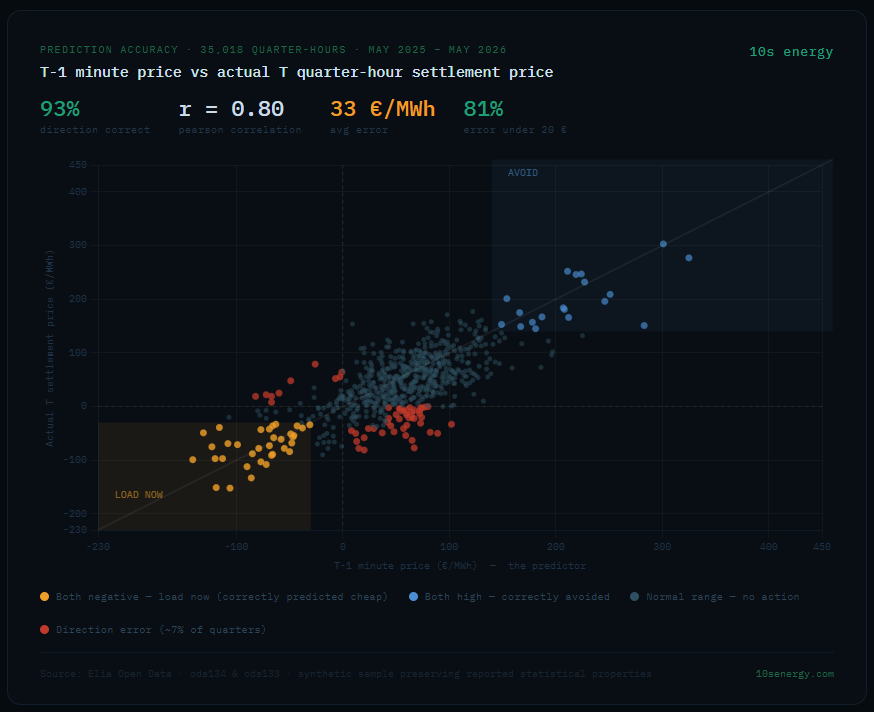
Every 15 minutes, Elia sets a price that determines whether it is cheap or expensive to use electricity right now. We analysed a full year of data to find out how well you can guess that price — before it happens.
First, what is an imbalance price?
The electricity grid has to be in perfect balance at every moment — as much power flowing in as flowing out. When that balance tips, Elia (Belgium's grid operator) steps in to correct it, by calling on power plants to ramp up or consumers to switch off. The imbalance price is the cost of that correction, settled every 15 minutes.
When the grid is short — more consumption than production — the price goes up, sometimes sharply. When the grid is long — more production than consumption, often on sunny or windy days — the price drops, and can even go negative. That means Elia effectively pays you to use electricity.
| WHY DOES THIS MATTER TO YOU? If you have a flexible load — an EV charger, a home battery, a heat pump — and you are connected to a supplier that passes through the imbalance price, you can save money by charging when the price is low and pausing when it is high. The question is: can you know in advance? |
The problem: the price is published after the fact
Elia only publishes the official 15-minute price after the quarter-hour ends. By then, it is too late to act. So the real question becomes: can you make a good enough guess at the start of a quarter-hour to decide whether to load or not?
Fortunately, Elia also publishes a stream of real-time data that updates every minute: the current minute-by-minute price estimate, the system imbalance in megawatts, and the activation prices of the balancing bids. This data is free and publicly available. We used it to build a predictor and tested it against one full year of actual outcomes.
The short answer: yes — most of the time
The single most useful signal is the last published minute price from the previous quarter-hour. You have that number before the new quarter-hour even starts. Here is what it tells you:
| DIRECTION CORRECT 93% positive or negative, correctly called | AVERAGE ERROR 33 €/MWh mean absolute error on the price level | ERROR UNDER 20 € 81% of all quarter-hours | PRICE CORRELATION 0.80 T-1 to T, Pearson r |
In plain terms: if the previous quarter-hour had a very low or negative price, there is a 93% chance the next one will too. If it was high, it will almost certainly stay high. The exact number is harder to pin down, but the direction — should I load now or not? — is reliable enough to act on.
| THE KEY INSIGHT For a home automation, you do not need to know the price is going to be exactly -47 €/MWh. You just need to know it is going to be very low. The direction signal alone is enough to make good decisions. |
It gets better if you wait 5 minutes
You do not have to decide at the very start of a quarter-hour. Most flexible loads — EV chargers, batteries, heat pumps — can tolerate a few minutes' delay. If you wait just 5 minutes and check the first few real-time minute prices of the new quarter-hour, the prediction improves noticeably.
| :00 | Quarter-hour starts — decide now? Use last minute price from previous quarter. Average error: 33 €/MWh. Direction: 93% correct. |
| :03 | Wait 3 minutes Average of 3 real-time minute prices. Error drops to 26 €/MWh. Direction: 94% correct. |
| :05 | Wait 5 minutes — recommended Error: 23 €/MWh. Direction: 94% correct. Good balance between speed and accuracy. |
| :10 | Wait 10 minutes — most accurate Error drops to 18 €/MWh, direction 95% correct. But only 5 minutes left to benefit. |
| :15 | Quarter-hour ends — price is published Too late to act. Elia confirms the official settlement price. |
How accurate is 'accurate enough'?
What counts as a good prediction depends on what you want to do with it. The three scenarios below cover most home automation use cases.
| ▼ Very cheap — load now Price below −50 €/MWh. These moments are rare (3.7% of the year) but valuable. The predictor catches 71% of them in advance. When it fires, the average actual price is −153 €/MWh — deeply negative. | — Normal — do nothing Price between 0 and 100 €/MWh. This is 70% of all quarter-hours. No particular action needed. The predictor correctly identifies this zone 9 times out of 10. | ▲ Very expensive — pause loading Price above 150 €/MWh. Once a high-price regime starts, it persists: 96% chance it continues next quarter. The predictor reliably detects these and triggers a pause. |
Prices tend to stay where they are
One of the most useful properties of the Belgian imbalance price is its tendency to persist. Once the price is in a regime, it tends to stay there. This is what makes the previous quarter-hour such a strong predictor.
High price stays high 96%
Low price stays low 71%
Direction correct overall 93%
Error under 20 €/MWh 81%
High-price regimes are stickier than low-price ones. A negative price can flip back to positive within one quarter-hour — it is a short-lived opportunity. A high-price period tends to last longer and is easier to avoid.
It varies by time of day
Not all hours are equally predictable. Overnight and early morning (midnight to 6am), prices are stable and the predictor performs well. The trickiest times are the morning ramp (7–9am) and evening peak (17–20h), when demand changes rapidly and the grid moves between states.
| RULE OF THUMB Trust the predictor most during stable periods: nights, weekends, and midday on sunny days (when solar is predictably high). Be more cautious during morning and evening peak hours on weekdays — that is when the market is most likely to surprise you. |
It varies by season
| Summer (Jun–Aug) 15% negative quarter-hours. Solar production creates frequent low-price windows, especially midday. Good for opportunistic loading. Average price was 69 €/MWh. | Spring (Mar–May) 13% negative quarter-hours. Variable — wind and solar mix creates both dips and spikes. The week of 6 April 2026 had extreme prices in both directions. Average: 68 €/MWh. |
| Autumn (Sep–Nov) 11% negative quarter-hours. Prices start climbing as heating demand grows. October and November are the start of the high-price season. Average: 76 €/MWh. | Winter (Dec–Feb) Only 4% negative quarter-hours. High heating demand keeps prices elevated. January 2026 averaged 116 €/MWh. Fewer opportunities to load cheaply, but high-price avoidance matters more. |
What the predictor cannot do
There are situations where even the best real-time signal gives you no warning. The most common is a late-quarter MARI activation — when Elia calls on large balancing bids in the last few minutes of a quarter-hour, the price can jump from 80 to 300 €/MWh with no advance signal in the per-minute data.
| KNOWN FAILURE MODE On 6 April 2026, five consecutive quarter-hours settled at −15,000 €/MWh — an extreme event with no precedent in the prior year. The per-minute data showed nothing unusual. Any automation that acted on these would have been very lucky, not smart. For this reason, the system includes a filter that ignores any price outside ±500 €/MWh as likely noise. |
The overall error distribution tells this story: 64% of quarter-hours have a prediction error below 10 €/MWh, and 81% are below 20 €/MWh. But the remaining 19% includes a long tail of large errors — mostly driven by these late-quarter activation events. For a home battery, you can afford the occasional missed spike. For a commercial BRP with strict settlement obligations, you would need a more sophisticated model.
The bottom line for home automation
Here is what the data says you can reasonably do:
| WHAT WORKS Load when the previous quarter-hour price was below −50 €/MWh. This fires around 1,300 times per year (3.6% of quarters), mostly in summer and spring. When it fires, the average price you actually pay is −153 €/MWh — the grid is genuinely long and Elia is happy to see you consume. Wait 5 minutes after the quarter starts to confirm the signal before activating. Pause when the price is above 150 €/MWh. Once you are in a high-price regime, 96% chance the next quarter is also high. No need to rush back — wait for a clear drop below 50 €/MWh before resuming. |
| WHAT DOES NOT WORK Trying to trade the exact price level. The average error of 33 €/MWh means you cannot reliably distinguish between, say, 60 and 90 €/MWh. The signal is useful for extreme decisions — clearly cheap or clearly expensive — not for fine-grained optimisation. |
This explainer is based on a full-year analysis of Elia open data (datasets ods134 and ods133, May 2025–May 2026, 35,018 quarter-hours). The underlying data and Python analysis script are available for replication. All imbalance price data is published by Elia under an open data licence.